Issue | Description | Strategies |
Extended time in responses using asynchronous communication. | When using asynchronous communication the learners may have difficulties developing the tasks. This leads to never ending discussions because the learners take too long in responding to their classmates or to the class’ tasks. | Setting specific deadlines is a way to overcome this issue. However it is important to keep in mind that the students may have personal difficulties that might unable them to post. In this aspect it is important to tell the student to communicate to the teacher in order to find solutions to the problem. |
Lack of energy in Web-based courses in contrast to F2F. | The major issue in web-based courses is the lack of energy that F2F classes have. Spontaneity, and direct interaction are missing in virtual classes. | By using synchronous communication, through chats, skype conversations, also personalized tutoring through video-chats may help to overcome this issue. |
Certainty of learners doing their work. | At the time of developing distant courses how are we sure that the student that enrolled himself for the class, is the one that is taking the class? | One strategy to overcome this is to develop group work.Also through personal tutoring, students can feel that the process is with them. I also believe that it is a process of developing self-awareness towards professional development and its importance. |
Balance between Synchronous and asynchronous communication. | Synchronous and asynchronous communication have positive and negative aspects. How can we provide the correct balance between them? | The balance between these types of communication can be made depending on the course’s intentions. Synchronous communication can be use to follow up students inquiries and sharing of ideas. While asynchronous communication can be used for personal reflections. |
Inappropriate sharing from the students. | Students may share academic aspects that are not appropriate for the course because of its content. Probably because of strong vocabulary, or nonacademic materials. | Share with the students netiquette rules, keeping in mind the formal academic environment of the course. |
Friday, December 4, 2009
Issues and Strategies with E-learning

Synchronous and Asynchronous communication
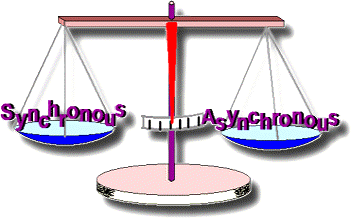
Haefner (2000) states some ideas that are relevant at the time of thinking in the development of a community in language learning. According to him, it is known that web-based courses lack the energy of F2F classes, and this thought brings to mind what is stated by Oblinger & Oblinger (2006), they say that many institutions are finding that students will assume responsibility for self-scheduling and self-policing. The gap between the responsibility of the learners and the lack of F2F energy in web-based courses must lead us to think in synchronous and asynchronous communication. We must think of classes that may have the energy that F2F classes demand, in order to do this, synchronous communication, through the use of skype, of chats, help us keep in mind the spontaneous thoughts that F2F classes have. However, asynchronous communication can guide us into a better thought when we reflect about certain topics, and allow narrowing the aspects that come up when discussing a topic. Sometimes F2F classes tend to make thoughts of the participants of the class become too general and even out of context.
The pedagogical implications of Haefner’s article (2000), rely on making teachers give a closer thought to the aspect of synchronous and asynchronous communication in our classes. He allows us to think beyond web-based classes, and also reflect on our F2F classes that use these types of communication. The concluding aspect of this article rely on keeping in mind a balance between these two types of communication because they both have positive aspects that can enhance our classes, but also they have drawbacks that can be overcome through the interaction of asynchronous and synchronous communication.
The learning Categories
Based on my experience with E-learning, This is my view of hoe the 7 categories of e-learning relate to me.
1. Courses
The experience of NLE has been a new one related to online learning. It is for the first time in our Masters degree courses that I have felt in an absolutely virtual environment. The Course has clear evaluating policies and clear starting and ending times.
2. Informal learning
I have had this learning experience in order to find tools that my students would enjoy. I learnt how to use Xtranormal, a site that creates animations by typing. In order to learn about this program I had to try it, manipulated and learn from it.
3. Blended learning
Many of our classes at this Masters course have been design in blended learning. My experience with these classes has been very interesting, because we used the F2F classes to discuss relevant issues that appeared in the online classes. It was interesting to find that we advanced faster in the topics that we developed online and very slow on the topics that we developed F2F.
4. Communities
I feel that we have gained a great bound of integration within the learning community of our semester. We have been able to discuss our problems in our teaching contexts and the situations that could enable us to create or advance in knowledge. Although every discussion that we do in virtual or F2F environments are part of an academic community, we also share our perceptions and personal situations with this community.
5. Knowledge management
I have not been involved in this category of e learning.
6. Networked learning
I have not been involved in networking environments, this is something that I believe is just being constructed with in our Masters community.
- Work-based learning (EPSS)
I have not been involved in this type of learning.
The Psychology of learning Environments
Analyzing our Moodle course management system according to the model of usability criteria:
1. Learnability: Through my experience I found Moodle very easy to learn, I understood what the teachers wanted me to use and how to use it. However, there are still some problems related to wikis that I have found difficult to use such as uploading pictures and resizing them.
2. Efficiency: I have been able to upload videos and audios with ease and with simple steps at the time of using Moodle. I have found very easy to get acquainted with what the teachers expect from me by using the platform.
3. Memorability: The steps to use Moodle are simple and easy to remember, so I could say that knowing how to use Moodle is like learning how to ride a bike, you will never forget how. But it is important to take into account that if the platform changes drastically like programs such as Microsoft Word (from the previous version to the actual one), one needs to study the program or platform in order to remember recognize the basic tools of it.
4. Errors: I think that the errors of using Moodle that came up during our Masters program is related to answering posts. At the beginning we did not know how to answer posts so what we did was create new posts to answer others instead of using the reply button.
5. Satisfaction: I feel comfortable using Moodle, so my personal experience with this tool has been gratifying. I have learnt to interact and develop ideas thanks to group discussions, and understood how to share ideas and feelings.
Careful, objective usability analyses of common digital environments should be conducted and problems should be addressed using similar decision-making processes and with the same sense of urgency that campuses apply when addressing poor conditions in brick-and-mortar classrooms.
Analyzing and comparing virtual and physical learning environments according to the 4 cognitive determinants of environmental preferente:
| | Coherence | Complexity | Legibility | Mystery |
| Moodle | In Moodle most of the courses are well organized and it is clear what the teacher expects from us. | There are some subjects that fall in repetitivity, so it is complex to maintain full attention in the tasks that are required. | It is very easy to use and easy to follow as long as teachers have clear ideas. | It may become repetitive and predictable; it depends on the teacher’s designed activities. |
| My school’s classroom | In F2F classes is not always clear what is expected from the variants of the classroom. | I can see if the students are tired or lost and I can develop activities in order to regain students attention towards the class. | Class circumstances may change and the topic that was planned for the day may shift in to a new topic. | Here it also depends on the teacher, since there are teachers that may also become predictable. |
The Role of Community
Taking into account the readings of Oblinger & Oblinger (2006) and Palloff, Rena and Pratt (2007) I consider the following the three most important issues about building community in virtual settings and its application on our NLE course:
- Almost any space becomes a gathering space that students can use for studying, collaborating, and socializing.
In our course we are never tight to be in a classroom in order to discuss topics. In my case, I can work on NLE from my house, my institution and at the University. In all these spaces we can study, socialize and collaborate. As a proof we can see our meetings on Tuesdays in order to discuss the topics of the week. However, I notice that we are not participating with each other’s comments and this leaves behind a type of interaction that is crucial for this type of learning environment.
- Many institutions are finding that students will assume responsibility for self-scheduling and self-policing.
The opportunity to allow ourselves our time management for this course is very convenient for a personal schedule. In my case I have had some personal issues that have not allowed me to work with the pace I would have wanted to. However, the possibility to work according to my personal time management has allowed me to catch up with work. This does not mean that deadlines are not an essential part of the learning process, on the contrary deadlines keep a regulation that is needed for any type of evaluated course.
- The ability to create a sense of presence online through the personalization of communications.
My Conception of Modern Learning Spaces

Reynard (2009) criticizes the fact of having placed settings for learning, according to her “most classrooms still suffer from "the fireplace" syndrome”, which is having furniture placed in specific parts of the class, when there are possibilities of gaining new developments through different settings that allow learners to be comfortable at the time of developing learning. However I believe that students need a lot of guidance for becoming autonomous when working in their tasks.
In my opinion the fact of adapting new technologies to learning is not a matter of changing learning spaces, it is a matter of developing autonomy through the use of IT. Students need to be in contact with the technology they are facing and they need to develop new literacies that allow them to understand the world.
If we were to talk about learning theories in new learning environments it would be important to consider Brown’s (2005) ideas as to the implementation of new learning spaces. He talks about the paradigm of the learning (constructivism) and teaching (traditional) paradigm, where memorization is replaced with understanding and repetition with transferring and construction, among other differences. The relation to new learning environments is the way Net Gens develop these strategies in the process of learning. In my opinion learning theories have become an eclectic mixture of what Brown calls paradigms. There is a possibility of finding needs to what and how we need to teach certain topics, for this reason we can develop, mix, adapt, enhance, create, and test new learning spaces within new or old settings and also new and old learning theories.
The Relevance of Multiliteracies
Literacy has a lot to do with language teaching. Literacy has to do with the basic competence that any one needs to use a language. However the idea of Literacy at the time of learning a second language changes according to the needs of the learner, for instance a learner may be more interested in using a language for speaking rather than reading or writing. However, the learner does need basic skills in order to understand in a minimum way the language in all its forms. When talking about literacy we should view it from a newer perspective, according to UNESCO[1], literacy is the "ability to identify, understand, interpret, create, communicate, compute and use printed and written materials associated with varying contexts. Literacy involves a continuum of learning in enabling individuals to achieve their goals, to develop their knowledge and potential, and to participate fully in their community and wider society." This idea opens a little more our view towards the definition of literacy, and creates a new perspective towards what many authors call Multiliteracies.
When talking about multiliteracies we would have to talk of an enhancement to develop knowledge besides the basic tools that reading and writing give us. Bamford (2003)[2] talks about the Visual literacy, which enables us to understand and define the context by images. It is no new knowledge that nowadays the image is an essential aspect of the world, every day we take images in order to accept or reject our perceptions. In this case it is true that we need to educate our observation in order to be critical. In language learning Visual literacy implies interpreting contexts that enable us to use the correct form of the language. When observing a piece of art we can enhance our perception of art, and use speaking as a medium to interpret the world that the art piece gives us since, as Bamford states, “Contemporary culture has become increasingly dependent on the visual especially for its capacity to communicate instantly and universally.”
Another literacy that is worth mentioning for its implications in LT is critical literacy. According to Lima (2006)[3], “Critical literacy is an educational practice that focuses on the relationship between language and world views, social practices, power, identity, citizenship, intercultural relations and global/local issues.” I believe that this literacy is a basic standard for any school subject at the time of learning. To be critical involves acquiring a view of the world and a view of oneself. I have always believed that before language teachers we should be teachers for life itself. So the link between LT and CL is nothing more than a connection of life long learning with language learning.
Even though there are many other important literacies such as cyber-literacy, which is the basis for the net generation that we are facing nowadays, I believe that the ones I mentioned are basic for language teaching. It is a must that language teachers see beyond the simple knowledge of literacy and be aware of Mulititeracies, since we are not just teaching a language, we are going beyond, we are teachers for life, and we must know and understand the tools that our learners need. In this sense Multiliteracies open a space for constant reflection of our teaching practice so the implication of mutiliteracies in language learning is understanding that we can go beyond simple teaching and become life long learning teachers.
[1] Literacy in the Information Age: Final Report of the International Adult Literacy Survey, OECD 2000. PDF
[2] Bamford, A. (2003) The Visual Literacy White Paper. Adobe Systems. Retrieved from http://www.adobe.com/uk/education/pdf/adobe_visual_literacy_paper.pdf
[3] Lima, C. (2006) A Brief Introduction to Critical Literacy in English Language Education. British Council Brazil. Retrieved from http://www.criticalliteracy.org.uk/images/cleltbooklet.pdf
